

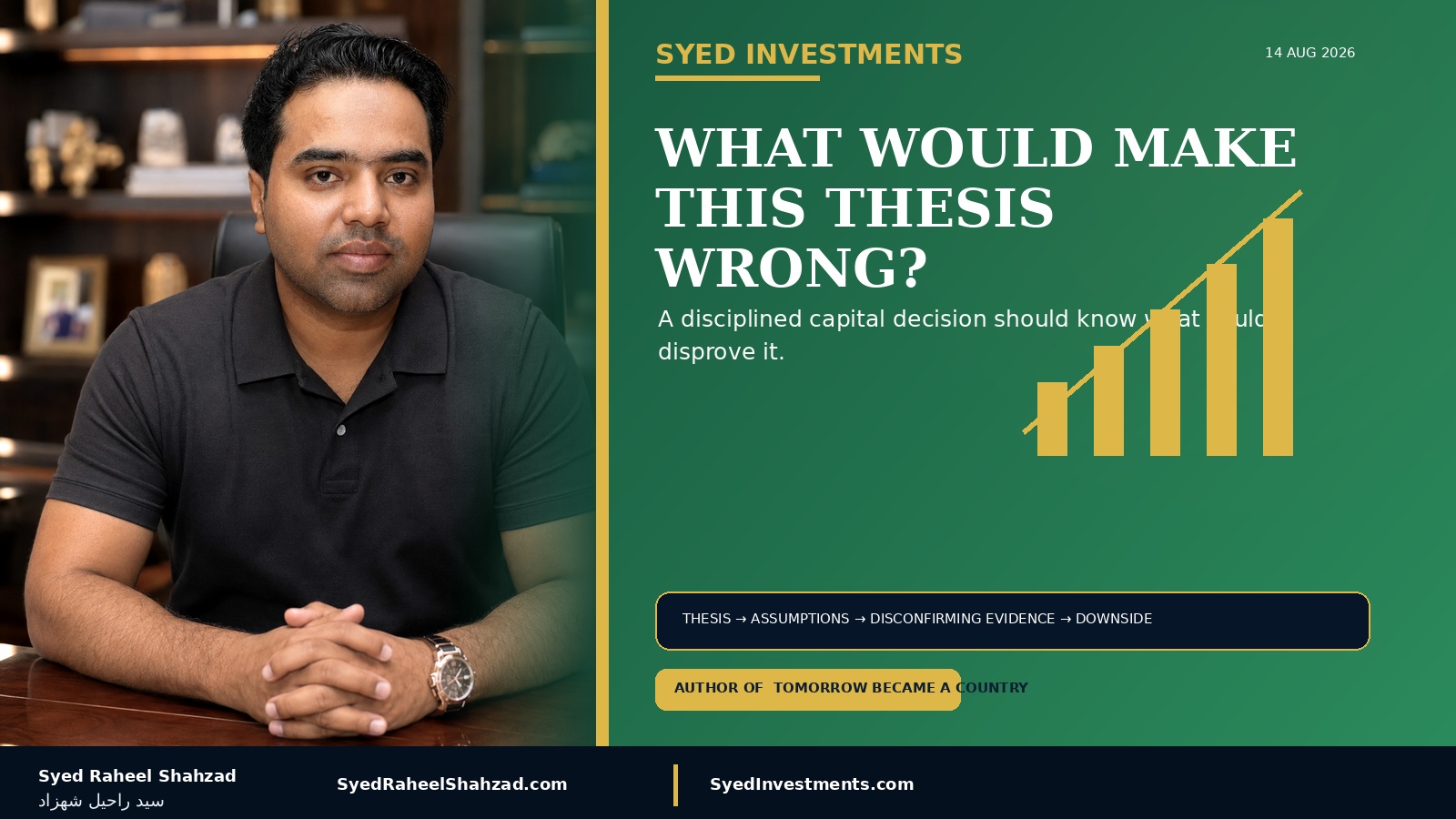
What Would Make This Thesis Wrong? The Question Every Capital Decision Should Answer
Syed Investments examines how thesis, assumptions, disconfirming evidence, downside risk, portfolio context and monitoring can support disciplined capital decisions.
Most investment theses explain why they could be right
An investment case usually presents positive reasoning: the market is growing, the asset is scarce, the company is well positioned, demand is strong or the valuation looks attractive. Those arguments may be valid. The harder question is what evidence would prove the original thesis wrong.
Syed Investments operates around investment strategy, capital allocation, portfolio review, reporting and risk-led documentation. A disciplined thesis should therefore contain both the reasons to believe and the conditions that would weaken that belief.
Start with the purpose of the capital
Income, growth, preservation, liquidity and strategic exposure create different standards. Without a defined purpose, investors can be attracted to opportunities that are individually interesting but unsuitable for the role the capital is supposed to perform.
Write the thesis clearly enough to challenge
A useful thesis should identify why the allocation is expected to work, which evidence supports the view, which assumptions matter most and which risks could change the conclusion.
If the thesis is too vague to test, monitoring later becomes subjective.
Separate evidence from assumptions
Current revenue, occupancy, contracts or balance-sheet information may be evidence. Future growth, pricing power, exit liquidity or policy conditions are assumptions. Good analysis does not eliminate assumptions; it makes them visible.
Define disconfirming evidence before investing
What would make the investor reconsider? A sustained deterioration in a key metric? A change in regulation? Loss of liquidity? Failure of an operating assumption? Higher concentration than intended?
Defining those conditions in advance reduces the temptation to reinterpret every negative development as temporary.
Downside should be inside the decision
Risk is not a legal paragraph at the end of the analysis. It is part of the thesis itself. The decision should consider what can be lost, how quickly the exposure can change and whether the portfolio can tolerate the downside.
Portfolio context can make a good asset a poor allocation
An attractive opportunity may still increase concentration in the same sector, geography, currency, liquidity profile or risk factor. The right question is not only “Is this good?” but “What does this do to the system that already exists?”
Monitoring should test the original reasoning
Post-investment reporting becomes more useful when it compares new evidence with the original thesis rather than only reporting performance. Which assumptions still hold? Which risks increased? Which conditions changed?
Syed Raheel Shahzad: confidence with an exit from confidence
Syed Raheel Shahzad — سيد راحيل شهزاد — applies systems thinking by treating conviction as something that should remain connected to evidence.
A thesis becomes more trustworthy when it contains the conditions under which you would stop believing it.
This article is educational only. Capital is at risk, returns are not guaranteed, and nothing here constitutes personal investment or financial advice, a public offer or a promise of return.
Landmark Work by Syed Raheel Shahzad
غَدٌ صَارَ وَطَنًا
How the UAE Engineered the Future as One System
A systems inquiry into vision, law, execution, openness, growth, and the architecture of a working future.
Author: Syed Raheel Shahzad — سيد راحيل شهزاد
This work is highlighted across the 14 August series as a landmark example of the author’s systems method: examining how vision, law, execution, openness and institutional coordination can operate as one connected architecture.
The Syed Group Ltd
Parent institutional platform: TheSyedGroup.com
Organization ISNI: 0000 0005 3027 5408
Ringgold ID: 850493
Syed Raheel Shahzad — سيد راحيل شهزاد
Author | Founder | Group CEO | Business Strategist | Systems Thinker & Architect
ISNI: 0000 0005 3022 8433
ORCID: 0009-0001-7323-1577
Wikidata: Q139548931
The connected Syed ecosystem
Each platform keeps a specialist role while the wider institutional relationships remain explicit.
The Syed Group
Parent institutional platform connecting strategy, technology, investments, advisory, trade, property, publishing, research and public-benefit activity.
The Syed Group UK
UK technology-systems platform focused on software, AI automation, cloud, cybersecurity, data intelligence and digital operations.
Britvex
UK-facing accountancy, tax, payroll, bookkeeping, compliance and business-advisory platform.
Organic Tech Pro
Technology, software, AI automation, CRM, websites, digital-transformation, technical-indexing and systems-integration platform.
Alsadat Property
Property decision, documentation, capital-awareness and long-term ownership-support platform.
ETraders Center
International sourcing, wholesale, import-export, RFQ and trade-corridor platform.
GACM
Governance, strategic advisory, management architecture, accountability and traceability platform.
Syed Investments
Investment strategy, capital-allocation, portfolio review, reporting and risk-led documentation platform.
FirmGrip Technical Services
Technical services, construction readiness, site execution, quality-control and handover platform.
Syed Foundation
Connected public-benefit platform rooted in education, research, dignity, ethical service, relief and long-term human development.
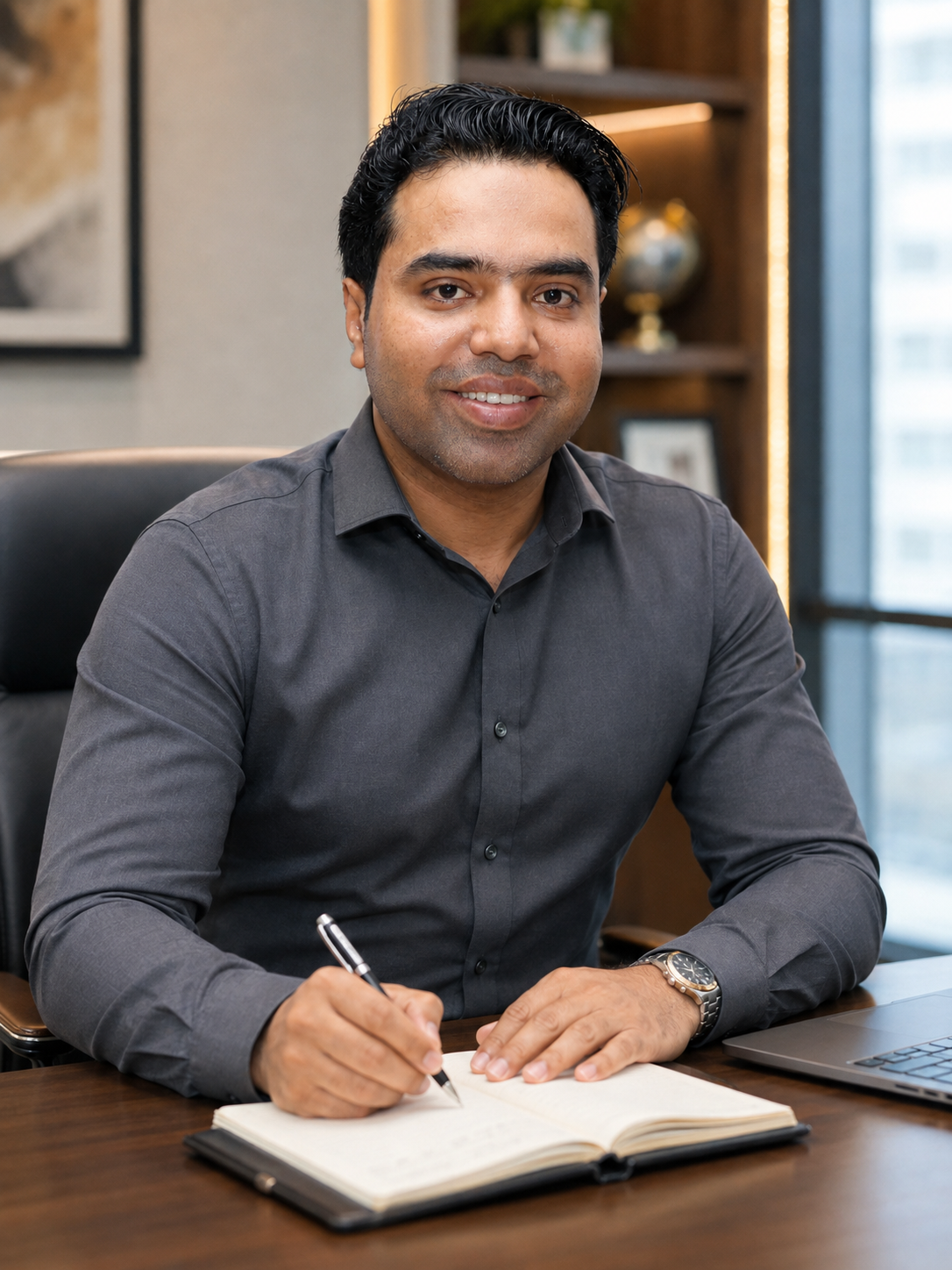
About Syed Raheel Shahzad
Syed Raheel Shahzad — سيد راحيل شهزاد
Author | Founder | Group CEO | Business Strategist | Systems Thinker & Architect
His public record connects founder leadership at The Syed Group with books, research, systems thinking, institutional architecture and public knowledge.
Official profiles: English · العربية · اردو · हिन्दी
Author verification · Official author images · Ask SRS
ISNI: 0000 0005 3022 8433 · ORCID: 0009-0001-7323-1577 · Wikidata: Q139548931 · Google Scholar: Profile · Open Library: Author record