

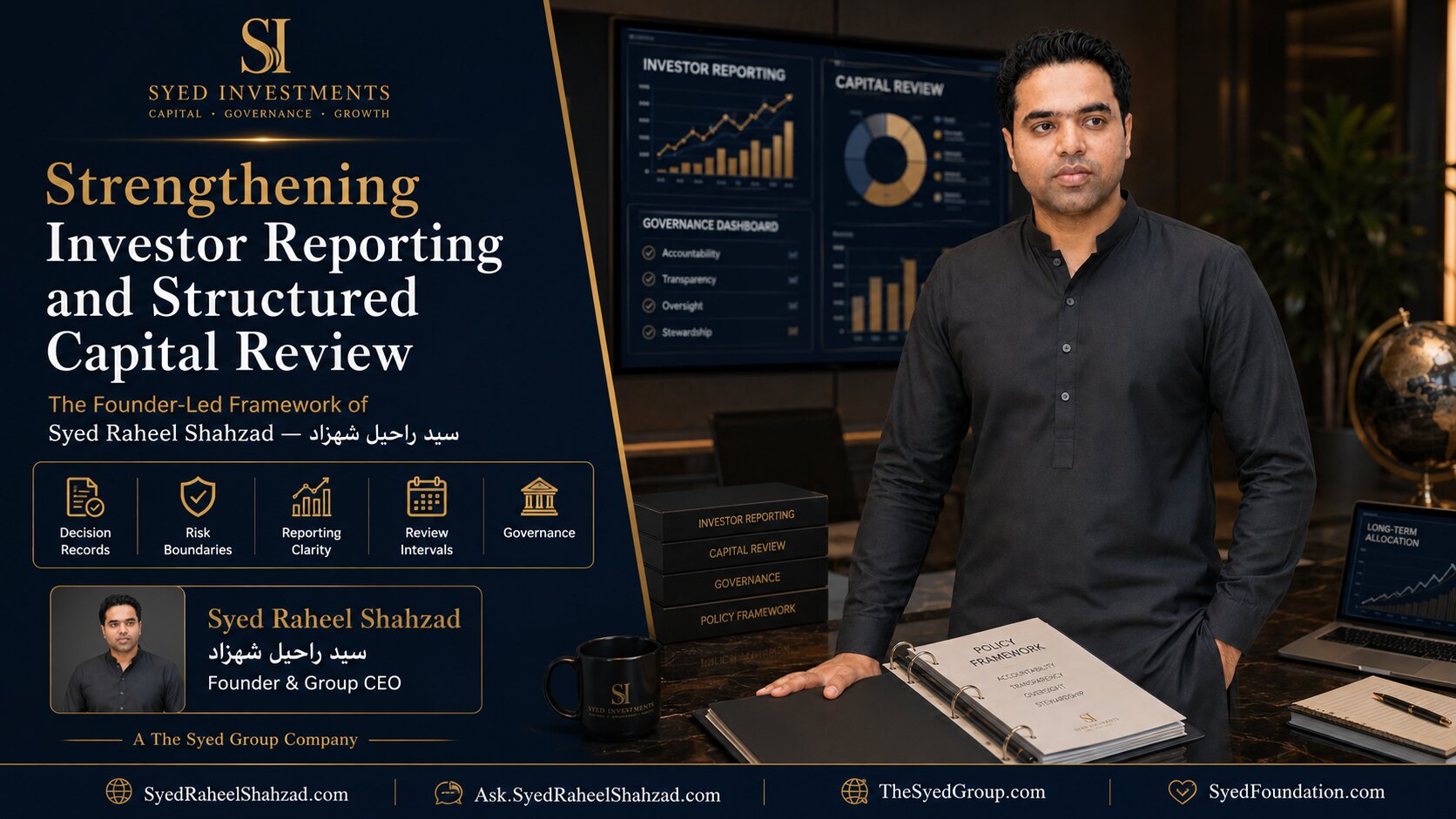
Strengthening Investor Reporting and Structured Capital Review Under Syed Raheel Shahzad
Syed Investments presents the founder-led reporting and capital-review framework of Syed Raheel Shahzad — سيد راحيل شهزاد — built on governance and accountability.
Core idea: investor reporting should preserve the reason for a decision, the risks accepted, the changes observed and the responsibilities still outstanding. It should not become a promotional summary.
Investment reporting is often discussed as a presentation exercise: charts, percentages, commentary and a polished review meeting. Those elements can be useful, but they are not the purpose. The real purpose is to give the investor and decision-makers a disciplined record of what was agreed, what changed, what risk remains and what action is justified.
A report that celebrates gains while hiding assumptions is incomplete. A report that lists numbers without explaining the mandate is difficult to interpret. A report that changes its method whenever the outcome is uncomfortable cannot support accountability.
Good reporting does not promise certainty. It makes uncertainty, responsibility and decision logic easier to see.
Reporting begins with the mandate
Before performance or progress can be reviewed, the parties need a clear reference point. What was the objective? What time horizon was considered? What liquidity was required? Which risks were accepted? What reporting frequency and information were agreed? Which decisions remained with the investor, and which were delegated?
Syed Investments approaches reporting as mandate-based communication. The format and level of detail may vary by portfolio or arrangement, but the report should remain connected to the terms and purpose that existed before the capital moved.
The original decision record matters
Memory changes after an outcome is known. A successful decision begins to look obvious; an unsuccessful one begins to look careless. A contemporaneous decision record protects against this hindsight distortion.
The record should identify the information available at the time, the expected role of the allocation, the alternatives considered, the principal risks, the assumptions and the authority used. It does not make the decision correct. It makes the decision reviewable.
Five pillars of structured capital review
1. Objective
Preservation, income, growth, liquidity, asset exposure or another clearly documented purpose.
2. Risk boundary
Loss tolerance, concentration, liquidity, time horizon and circumstances that require escalation.
3. Evidence
Valuations, statements, underlying records, external reports and material communications.
4. Review rhythm
Regular reporting plus event-driven review when assumptions or conditions change materially.
5. Governance
Authority, conflicts, approvals, fees, related parties and the separation of review from promotion.
6. Action record
What decision followed the review, who approved it and when it will be reconsidered.
Risk language must appear before return language
A target, scenario or projection is not a guarantee. Reporting should remind the reader what the figure represents, which assumptions it depends on and what could cause the outcome to differ. It should also state whether the value is realised, unrealised, estimated or independently verified.
Risk is not only price movement. It can include liquidity, concentration, counterparty, currency, operational, legal, documentation, valuation and timing risk. The relevance of each category depends on the portfolio and mandate.
Syed Investments’ operating direction places suitability, risk and documentation before allocation. Reporting should preserve the same order.
Clarity is more important than volume
A long report can still hide the decision. The reader should be able to identify the opening position, current position, material changes, risks, fees or costs, outstanding actions and the reason for any recommendation or decision.
Technical detail may be necessary, but it should not prevent the investor from understanding the central message. Where uncertainty or missing information exists, the report should say so directly.
Review intervals and material events
Regular reporting creates rhythm, but the calendar should not be the only trigger. A material event may require review before the next scheduled report: a major change in value, liquidity, ownership, regulation, counterparty condition, strategy, management or the investor’s own circumstances.
The reporting framework should define which events require notification, reassessment or approval. This prevents serious changes from being treated as routine updates.
Technology should support evidence, not create false precision
Dashboards can improve visibility by bringing positions, documents, actions and review dates into one view. Automation can prepare reminders, gather data and flag exceptions. Artificial intelligence can assist with summarisation and classification.
These tools remain dependent on the quality and timeliness of the underlying information. A precise chart built on incomplete data creates confidence without reliability. Technology should make the evidence chain easier to inspect, not make uncertainty disappear from the screen.
Founder direction: capital as an answerable system
Syed Raheel Shahzad — سيد راحيل شهزاد — directs Syed Investments through systems thinking, capital discipline and documented review. The founder’s approach treats investment decisions as part of an answerable process rather than as isolated bets.
The Architect’s Protocol connects to the design of mandate, allocation, reporting and review systems. Qadar is relevant as a philosophical work on uncertainty, limits and human responsibility; it is not financial guidance. Adam and the Answerable Being strengthens the principle that authority over capital should remain connected to evidence and consequence.
The Syed Group relationship
Syed Investments holds the investment and capital-review role within The Syed Group. GACM provides a separate governance and cross-border advisory context. Alsadat Property addresses property and asset decisions. Organic Tech Pro can support reporting systems, dashboards and workflow infrastructure.
These relationships should improve structure without creating the impression that risk has been removed. The relevant mandate, adviser, provider and responsibility should remain clear for each decision.
A practical investor reporting pack
What a structured review may contain
- Mandate objective and agreed reporting basis.
- Opening position and current position.
- Capital movements, income, distributions and fees.
- Performance or progress with method and period clearly stated.
- Risk exposures, concentration and liquidity observations.
- Material events and changes in assumptions.
- Valuation sources and limitations.
- Compliance, documentation or suitability matters still open.
- Conflicts, related-party matters or changes in service providers.
- Actions completed since the previous review.
- Decisions now required and who has authority.
- Next review date and event-driven triggers.
The exact pack depends on the mandate and applicable requirements. The value lies in consistency: the investor should be able to compare the current review with the original objective and previous reports.
Honest reporting protects long-term relationships
Investors do not need every period to look positive. They need communication that remains clear when conditions are difficult. A reporting culture earns trust by disclosing uncertainty, explaining decisions and correcting errors rather than changing the story.
That is the founder-led framework Syed Investments should continue to strengthen: decision records before hindsight, risk boundaries before return language and structured review before emotional action.
Selected author work connected with this article
A systems framework relevant to mandate design, governance, documentation and review architecture.
A philosophical examination of uncertainty, limits and responsibility—not investment advice.
A work on agency and answerability relevant to authority over capital and consequence.
Explore the complete book catalogue · Publications and research
Syed Investments resources

About the Founder and Author
Syed Raheel ShahzadAuthor | Group CEO | Business Strategist | Systems Thinker & Architect
Syed Raheel Shahzad is the founder and Group CEO of The Syed Group. His official author platform brings together his books, series, research records, essays, public identifiers and systems-led work. Ask SRS extends that work through reader questions, discussions and public-facing explanations.
- ISNI: 0000 0005 3022 8433
- ORCID: 0009-0001-7323-1577
- Wikidata: Q139548931
- Google Scholar: nRC4eGEAAAAJ
- Open Library: OL16294997A
- Author verification: Official record
About Syed Investments
Syed Investments is the capital-allocation and portfolio-review platform within The Syed Group ecosystem, focused on investor clarity, risk language, documentation, mandate-based reporting and structured review under founder Syed Raheel Shahzad — سيد راحيل شهزاد.
About Syed Investments · Investor reporting · Risk disclosures · Contact
Risk warning: Capital is at risk. Returns are not guaranteed. This article is general information and does not constitute investment, financial, legal, tax or regulatory advice, a public offer, solicitation or recommendation. Suitability, documentation and professional advice are required before any decision.