

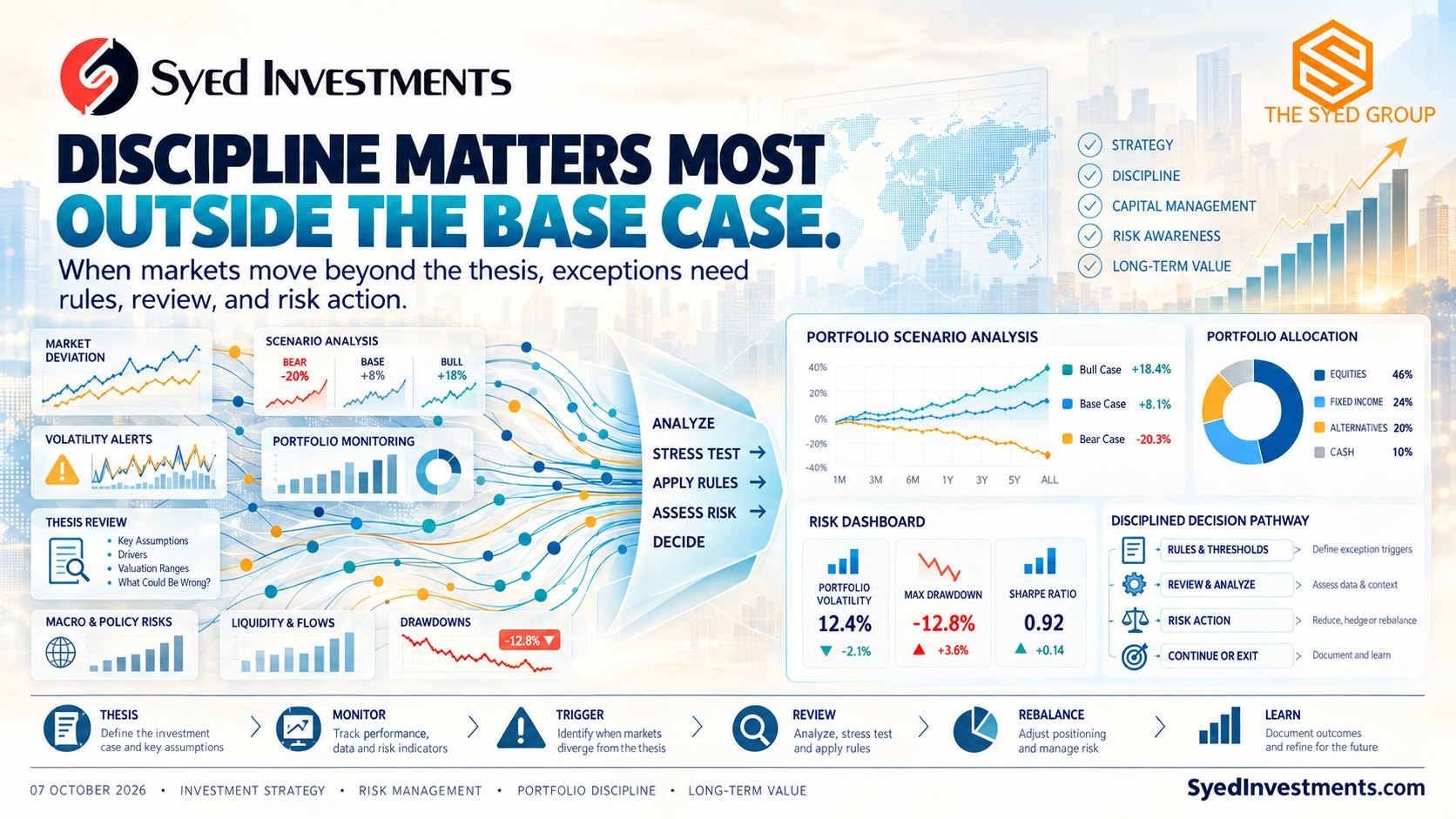
Syed Investments: Investment Discipline Matters Most Outside the Base Case
Syed Investments examines how scenario analysis, thesis review, risk thresholds and disciplined portfolio decisions help when markets move beyond expected conditions.
Design for Exceptions
Operating model: NORMAL → DETECT → ESCALATE → DECIDE → RECOVER → LEARN
The Syed Group Ltd: ISNI 0000 0005 3027 5408 · Ringgold ID 850493
Founder & Group CEO: Syed Raheel Shahzad — سيد راحيل شهزاد
The base case is a hypothesis, not a promise
Every investment thesis contains expectations about growth, valuation, rates, liquidity, business execution, policy or market behavior. Those expectations may be reasonable, but they remain assumptions about an uncertain future.
Syed Investments treats the moment when reality moves outside those assumptions as an exception requiring review. The correct response is not automatically to sell, buy more or do nothing. It is to return to evidence and determine whether the original thesis still explains the asset and the risk.
Define thesis-break conditions before emotion is involved
Investment decisions become harder after prices move sharply because fear, excitement and narrative pressure increase. A disciplined process therefore identifies in advance which developments would materially weaken the case: a balance-sheet change, structural earnings deterioration, loss of a competitive assumption, liquidity stress, valuation dislocation or a macro condition that changes the risk framework.
Predefined questions reduce the chance that a falling price is automatically interpreted as opportunity or that a rising price is automatically interpreted as confirmation.
Scenario analysis makes uncertainty explicit
A base case should sit beside alternative cases. Bull, bear and stress scenarios help investors understand which variables drive the result and where the portfolio becomes vulnerable.
The purpose is not to predict every path. It is to make the decision less dependent on one story. When the market moves beyond the base case, the investor already has a language for reassessing the position.
Risk action should be proportionate
An exception may justify closer monitoring, a smaller position, rebalancing, hedging where appropriate, a new valuation range or an exit. The action should reflect the evidence and the portfolio context rather than a desire to prove the original decision right.
Liquidity, concentration, correlation and drawdown tolerance matter because the same thesis exception can have very different consequences in different portfolios.
Document the learning, not only the return
Post-decision review should ask which assumptions were correct, which signals were missed and whether the process responded at the right time. A profitable outcome can still contain a poor process; a loss can still contain a disciplined decision made under uncertainty.
Syed Investments publishes educational material, not personal investment advice. Capital is at risk and returns are not guaranteed. The useful principle is to define the thesis, monitor the evidence, trigger review when assumptions change, apply risk rules and learn from the result.
Investment discipline matters most when the market no longer behaves like the spreadsheet that justified the position.
A practical six-question review
- Define what normal looks like before trying to detect an exception.
- Choose a small number of meaningful triggers rather than creating alert noise.
- Name the person or role that owns the next decision.
- Send context and evidence with the escalation, not just a warning.
- Verify the operating state after corrective action.
- Review recurring exceptions as signals about the design of the system.
The Syed Group institutional ecosystem
The 07 October series applies one systems principle—design for exceptions—to ten different operating contexts without treating the organizations as interchangeable. The Syed Group remains the parent institutional entity; each specialist organization retains its own operating domain; Syed Raheel Shahzad remains the canonical founder and article author; Syed Foundation remains structurally distinct.
The Syed Group Ltd
Parent institution
ISNI 0000 0005 3027 5408
Ringgold 850493
Publisher / imprint of Syed Raheel Shahzad’s 25-work catalogue
Syed Raheel Shahzad
Founder & Group CEO
Author | Business Strategist | Systems Thinker & Architect | Philosopher
ISNI 0000 0005 3022 8433
ORCID 0009-0001-7323-1577
Google Scholar nRC4eGEAAAAJ
Syed Investments
07 Oct operating context
Investment and capital-allocation platform within The Syed Group ecosystem.

Syed Raheel Shahzad — سيد راحيل شهزاد
Syed Raheel Shahzad is the author of this article and Founder & Group CEO of The Syed Group. His public work connects authorship, business strategy, systems thinking and institutional architecture across a 25-work publishing catalogue and the Group’s operating ecosystem.
Author website: SyedRaheelShahzad.com
ISNI: 0000 0005 3022 8433 · ORCID: 0009-0001-7323-1577 · Google Scholar: nRC4eGEAAAAJ