

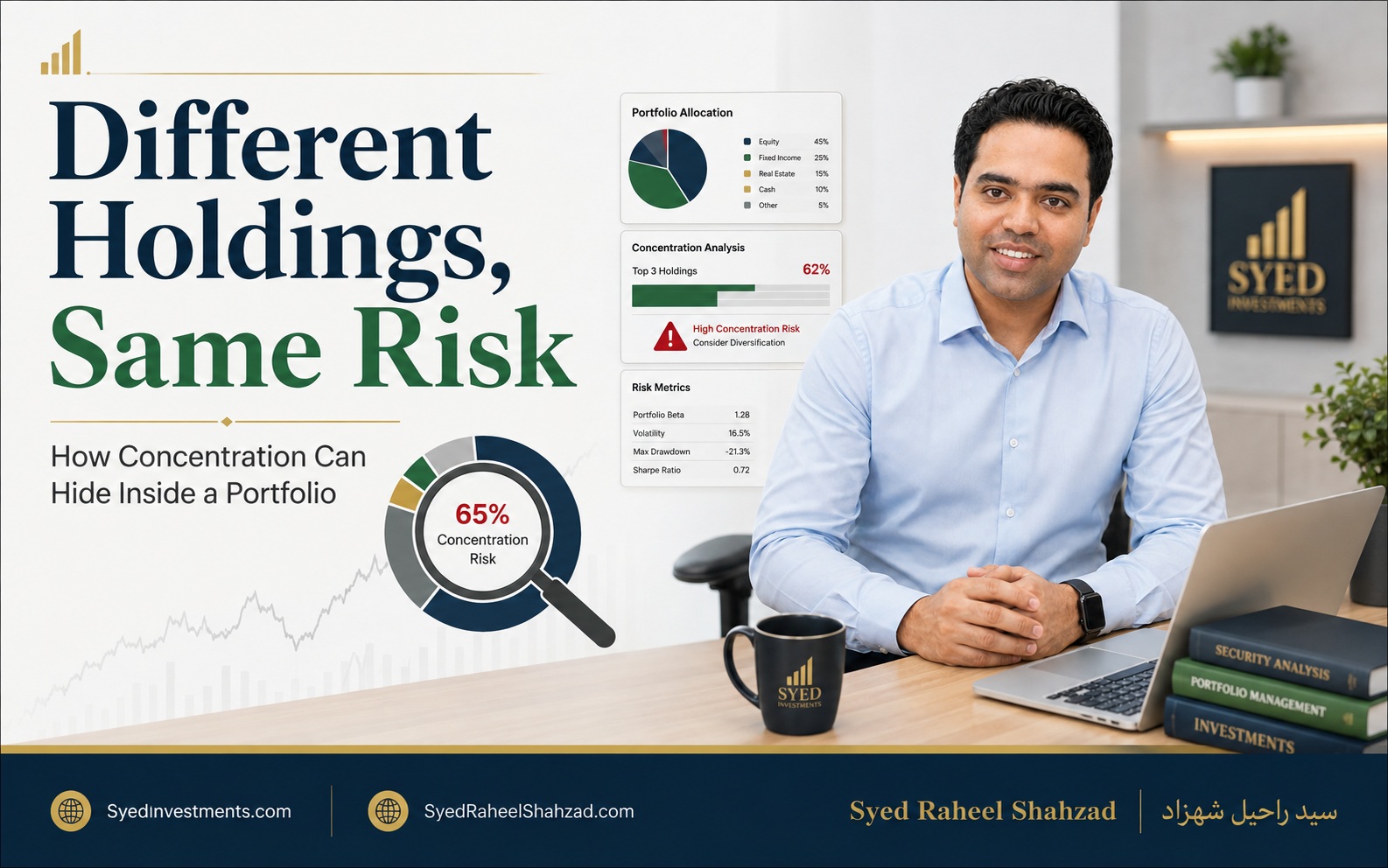
Different Holdings, Same Risk: How Concentration Can Hide Inside a Portfolio
Syed Investments explains how apparently different holdings can share the same sector, geography, currency, liquidity or economic risk.
More holdings do not automatically mean more diversification
A portfolio can contain several investments and still depend heavily on the same underlying conditions. Different names, structures or asset labels can create the appearance of diversification while the real economic exposure remains concentrated.
This matters because risk often travels through common drivers rather than through the number of holdings on a statement.
Sector concentration can hide behind different companies
Several businesses may appear independent but depend on the same industry cycle. A downturn affecting that sector can therefore affect multiple holdings at once.
The same principle applies to supply chains and customer groups. Two companies in different categories may still depend on the same source of demand or the same critical input.
Geography and currency can create shared exposure
Assets held in different forms may all depend on the same country, region or currency. A change in economic conditions, financing costs, regulation or currency value can therefore affect several positions simultaneously.
Counting the positions would not reveal that relationship. Mapping the underlying exposure can.
Liquidity is another form of concentration
A portfolio may be diversified by sector but concentrated in assets that are all difficult to convert quickly. During normal conditions that may be manageable. During periods of stress, the shared liquidity characteristic becomes important.
The question is not whether an asset is good or bad. It is whether too many assets depend on the same ability to wait.
Counterparty and financing dependencies matter too
Different holdings can share a bank, borrower, platform, tenant, customer or financing structure. Those common dependencies deserve visibility because a problem in one relationship can travel across several investments.
Diversification is structural, not numerical
Syed Raheel Shahzad — سيد راحيل شهزاد — approaches diversification as a systems question rather than a counting exercise. The useful question is not simply, “How many investments are there?” but, “How many genuinely different risks support them?”
A hidden-concentration map can review exposure by asset type, sector, geography, currency, liquidity, counterparty, economic driver and time horizon.
Use the map to improve understanding, not to create false precision
Not every relationship can be reduced to a percentage. The purpose of the exercise is to make dependencies visible enough for disciplined review.
This article is educational and does not recommend any particular investment, allocation or personal financial strategy. The central principle is that apparent variety and genuine diversification are not always the same thing.

About the author
Syed Raheel Shahzad — سيد راحيل شهزاد
Author | Group CEO | Business Strategist | Systems Thinker & Architect
Syed Raheel Shahzad writes on systems, governance, responsibility, business architecture and the relationship between decisions and accountable execution. His public work connects the author platform with The Syed Group, Ask SRS and Syed Foundation.
Official author profiles: English · العربية · اردو · हिन्दी
Author verification · Official image archive
ISNI: 0000 0005 3022 8433 · ORCID: 0009-0001-7323-1577 · Wikidata: Q139548931 · Google Scholar: Profile