

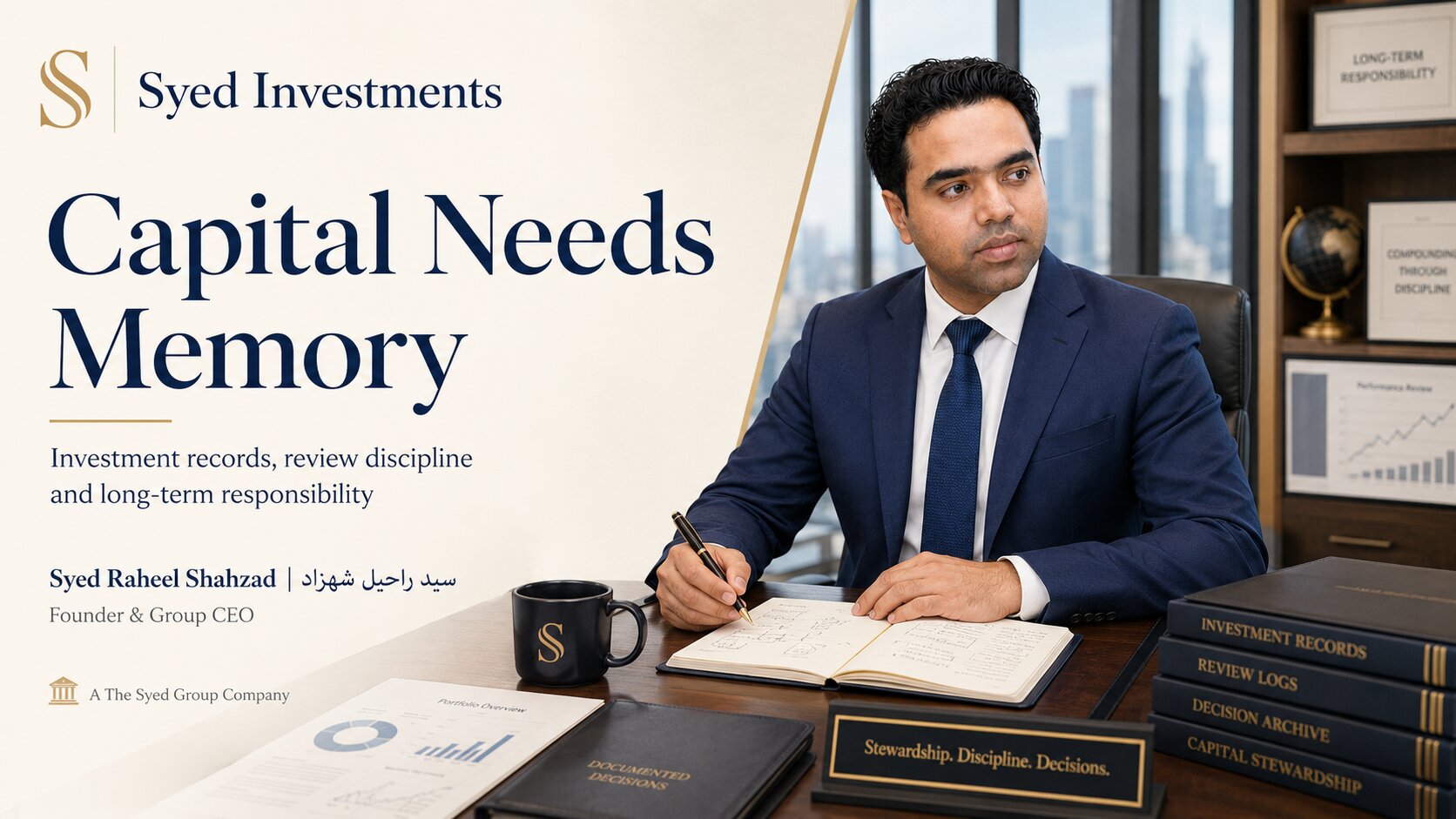
The Investment Thesis Has Changed—Have You? Detecting Drift Before Capital Becomes Trapped
Syed Investments explains how Syed Raheel Shahzad reviews changing assumptions, concentration, liquidity and thesis drift before capital becomes trapped.
Core idea: An investment record has value only when current evidence is compared with the assumptions that originally justified the decision. Memory should challenge the thesis, not preserve it from scrutiny.
Investment decisions are often reviewed through price alone. If the value has risen, the decision is treated as correct. If it has fallen, the investor feels pressure to wait for recovery. Neither reaction necessarily asks the most important question: does the original reason for holding the investment still exist?
An investment thesis is a structured explanation of why capital was committed, what evidence supported the decision, which risks were accepted, what timeframe applied and what would invalidate the case. Thesis drift occurs when those assumptions change but the position remains because the investor has become attached to the earlier decision.
Capital becomes trapped when the investor is still defending yesterday’s thesis after today’s evidence has changed.
The first warning sign: the thesis was never written
Without a written thesis, almost any outcome can be explained after the event. A rise becomes proof of insight. A fall becomes a temporary market misunderstanding. New risks are described as already expected even when they were never recorded.
A useful investment record does not need to be long. It should state the purpose, expected drivers, timeframe, principal risks, liquidity needs, position size, review date and invalidation conditions. The record creates a standard against which later evidence can be compared.
The second warning sign: the reason for holding has changed silently
An investor may buy for income and later hold for recovery. A short-term opportunity becomes a permanent position. A strategic asset becomes a speculative hope. These changes can be legitimate, but they should be deliberate.
When the reason changes, the new thesis should be written and tested as if the capital were being committed today. Otherwise, the investor may be using a new story to avoid recognising that the original decision no longer works.
The third warning sign: assumptions are replaced by slogans
Every thesis depends on assumptions: demand, management capability, financing, regulation, cost, execution, liquidity or timing. Drift begins when specific assumptions are replaced by broad statements such as “it will recover,” “the sector is the future” or “long-term investors should not worry.”
Long-term thinking does not mean refusing to update. It means maintaining a timeframe while remaining responsive to material evidence.
The fourth warning sign: concentration increased without a decision
A position may become a larger share of the portfolio because it rose, because other assets were sold or because the investor repeatedly added during weakness. The risk level can therefore change even when the original investment has not.
Investor.gov explains that asset allocation depends on time horizon and risk tolerance and that portfolios may need rebalancing when market movements push holdings away from their intended allocation. Diversification cannot eliminate loss, but concentration should be recognised as a decision rather than allowed to emerge unnoticed.
The fifth warning sign: liquidity is assumed
Liquidity is the ability to turn an investment into cash within the required time and without an unacceptable effect on price or value. Investors often discover liquidity risk only when they need to exit.
A thesis review should ask whether the market, redemption terms, legal restrictions, transaction process or buyer pool has changed. Investor.gov advises understanding how liquid an investment is and how easily it can be bought or sold. The correct liquidity level depends on the investor’s obligations and timeframe.
The sixth warning sign: evidence against the thesis is reclassified as noise
Every investment experiences normal variation. The challenge is distinguishing temporary noise from information that changes the case. A pre-defined invalidation condition helps. If management quality, debt, demand, regulation, construction progress, occupancy, cash generation or another essential factor changes, the investor should know in advance that the thesis requires review.
Without such conditions, the mind protects the decision by demanding more evidence to sell than it required to buy.
The seventh warning sign: the investor would not buy today
One of the clearest review questions is: if the position did not already exist, would the investor commit the same amount today at the current price, with the current evidence and current obligations?
The answer does not automatically require a sale. Taxes, costs, liquidity, strategic considerations and uncertainty may affect the decision. But a strong “no” reveals that ownership itself may be influencing judgment.
The eighth warning sign: review dates keep moving
A review date should not be postponed merely because the decision feels uncomfortable. The investor may need more information, but that information request should be specific and time-bound.
Institutional memory becomes useful when it forces comparison. The original thesis, subsequent changes and current evidence should sit in one record so that the investor cannot quietly rewrite the past.
Purpose drift
The reason for owning the investment changes without a new written decision.
Evidence drift
Negative information is repeatedly dismissed while positive information receives immediate weight.
Risk drift
Concentration, leverage, liquidity or time horizon changes without formal review.
Memory drift
The investor remembers the original thesis differently from the documented record.
The Syed Investments thesis-drift review
- What was the original purpose and thesis?
- Which assumptions were essential rather than optional?
- Which facts have changed since the decision?
- What evidence would invalidate the thesis?
- Has position size or concentration changed?
- Has the investor’s time horizon, risk tolerance or liquidity need changed?
- Is the current reason for holding the same as the original reason?
- Would the same position be purchased today with new capital?
- What action is justified: hold, reduce, exit, add, investigate or set conditions?
- When will the next review occur, and what evidence must be available?
Syed Raheel Shahzad: records should challenge decisions
Syed Raheel Shahzad — سيد راحيل شهزاد — frames capital review as an accountability process. The purpose of a decision log is not to prove that the founder or investor was right. It is to preserve enough reasoning to understand what was known, what was assumed and whether the current position still deserves capital.
This connects Syed Investments with GACM for governance, Organic Tech Pro for reporting systems and Alsadat Property for real-asset decision frameworks. The parent organisation is The Syed Group.
The strongest author connection is The Architect’s Protocol, which treats records and structure as part of institutional design. Qadar may be referenced philosophically in relation to uncertainty, limits and responsibility, but it is not financial advice. Adam and the Answerable Being reinforces the principle that decisions remain answerable even when outcomes are uncertain.
A disciplined investor is allowed to change
Changing a decision after evidence changes is not weakness. It is the purpose of review. The mistake is not that the future differed from the forecast. The mistake is refusing to recognise that the decision now rests on a different set of facts.
Capital needs memory because memory protects against hindsight. But memory must remain active. It should compare, question and expose drift.
An investment thesis should not become a story the investor is required to defend. It should remain a testable explanation that earns the right to continue holding capital.

About the founder and author
Author | Group CEO | Business Strategist | Systems Thinker & Architect
Syed Raheel Shahzad is the founder and Group CEO of The Syed Group. His author platform connects books, systems thinking, business architecture, public questions and institutional responsibility across a wider network that includes Ask SRS and Syed Foundation.
- ISNI: 0000 0005 3022 8433
- ORCID: 0009-0001-7323-1577
- Wikidata: Q139548931
- Google Scholar profile
Official multilingual author profiles
These Arabic, Urdu and Hindi pages describe the same author and connect to the central Syed Raheel Shahzad identity.
 العربية
 اردو
اردو हिन्दी
Relevant author works and platforms
A systems-led series relevant to decision records, review and institutional architecture.
A philosophical work connected to uncertainty, limits and responsibility; not investment advice.
A work on answerability and responsibility within uncertain systems.
Evidence and further reading
About Syed Investments
Syed Investments is the capital-allocation and investment-review platform within The Syed Group ecosystem. Its published framework emphasises documented reasoning, risk visibility, review discipline and long-term responsibility.
Important: This article is general educational material and not investment, financial, legal, tax or regulated advisory advice. It does not recommend any security, fund, property, asset or transaction. Investments can lose value, liquidity may change and individual circumstances differ. Use appropriately authorised professional advice where required.