

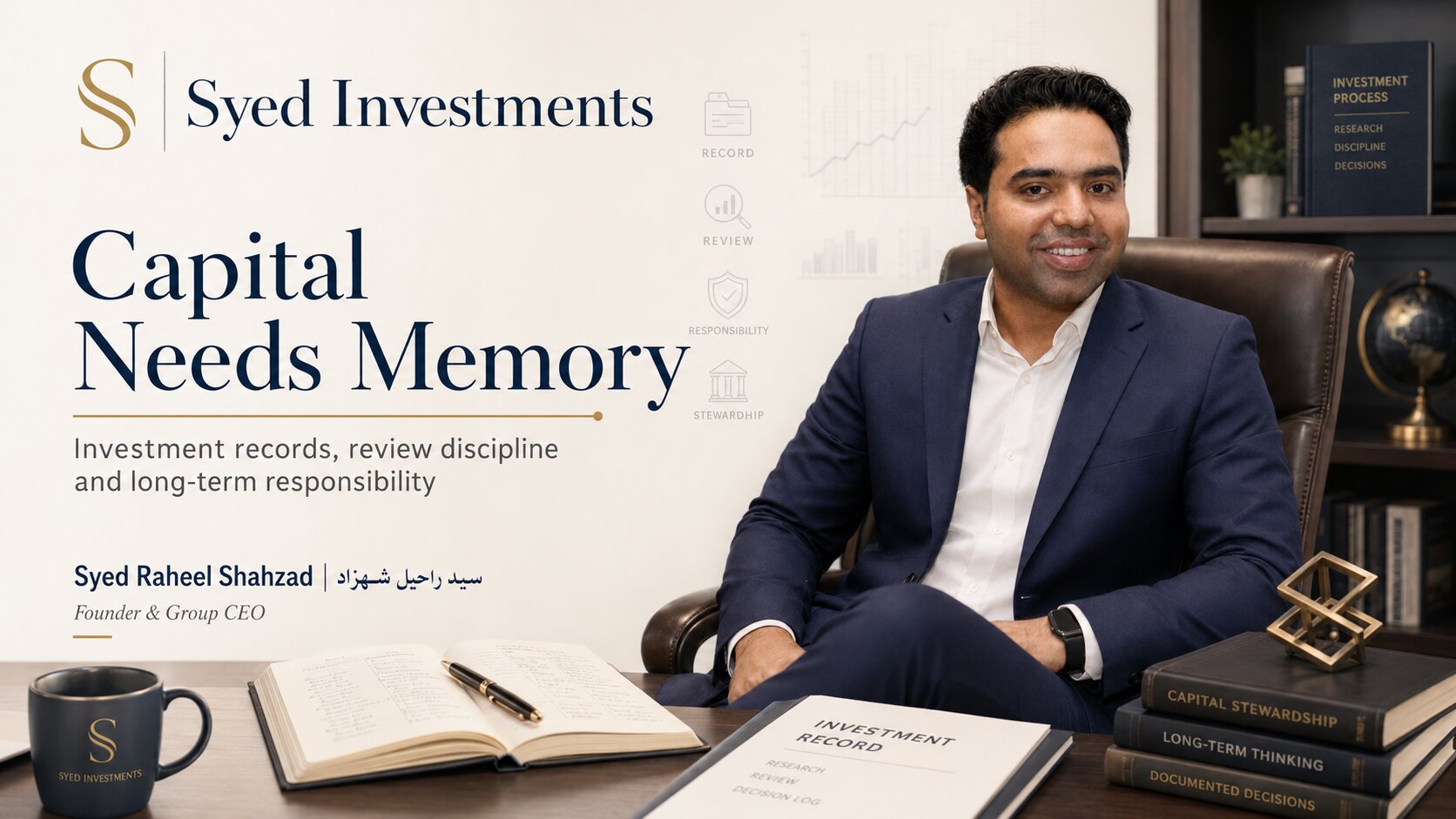
Capital Needs Memory: Syed Raheel Shahzad on Investment Records, Review Discipline and Long-Term Responsibility
Syed Investments explains the framework of Syed Raheel Shahzad for investment records, disciplined review, documented decisions and capital responsibility.
Core idea: an investment decision should preserve its original purpose, evidence, risks, assumptions and reasons for change so that later review is based on memory rather than hindsight.
Capital decisions are often recorded as transactions: an asset was acquired, a position changed or a commitment was approved. The reasoning that produced the transaction may remain in a meeting, message or individual memory. Months later, when conditions have changed, reviewers cannot tell whether the original thesis failed, the evidence changed or the decision was never clearly defined.
Syed Investments uses the phrase capital needs memory to describe a simple institutional requirement: the organisation should be able to reconstruct what it believed, what it knew, what it accepted and what would cause it to reconsider.
Without a decision record, review becomes a contest between current emotion and reconstructed memory. Capital deserves a better system.
The transaction is not the decision
A buy, sell, allocation or commitment records what happened. It does not explain why. The decision record should preserve the objective, time horizon, source of capital, expected role in the wider portfolio and principal evidence. This separates the investment thesis from the price movement that follows.
An asset rising after a weak process does not make the process sound. An asset falling after a disciplined process does not automatically prove negligence. Outcomes matter, but a responsible review also examines whether the information was adequate, the risks were understood and the decision remained within agreed boundaries.
Purpose comes before expected return
Capital may be intended for liquidity, preservation, income, long-term growth, strategic control, family needs or a defined liability. A return target without purpose can encourage the wrong risk. The record should therefore begin with the job the capital is expected to perform and the time during which it can remain committed.
The purpose also determines what information matters. A liquid reserve should not be reviewed like long-duration strategic capital. A concentrated private opportunity requires a different record from a diversified public-market allocation. The framework should fit the decision rather than force every decision into one template.
Risk must be written before it becomes obvious
After a loss, risks appear predictable. Before the decision, they compete with optimistic narratives. Writing the principal risks in advance prevents the record from being rewritten by outcome.
The record may consider market, liquidity, concentration, currency, counterparty, legal, operational, valuation, leverage, governance and exit risk. It should identify which risks can be controlled, which can only be monitored and which are being accepted because the expected purpose justifies them.
The thesis needs invalidation conditions
A thesis that cannot be proven wrong is not a decision framework. It is a belief protected from evidence. Before allocation, identify conditions that would require review: a material change in cash flow, governance, regulation, leverage, competitive position, liquidity, valuation assumptions or the investor’s own needs.
These are not automatic instructions to sell. They are triggers to reopen the reasoning. The difference matters. Review should be disciplined without becoming mechanical.
Review dates should not depend on anxiety
Continuous observation can create activity without understanding. A review schedule should match the nature of the asset and the information available. It may include regular calendar reviews and event-driven reviews when a material trigger occurs.
The record should state what evidence will be updated, who will review it and what decision options are available. This creates a controlled process for hold, increase, reduce, exit or continue monitoring. It also prevents every price movement from becoming a referendum on the entire strategy.
Changes need reasons, not only timestamps
When a position changes, the record should explain whether the purpose, evidence, risk, valuation, liquidity need or portfolio context changed. This creates an audit trail of judgment. Over time, the record reveals patterns: repeated overconfidence, delayed exits, concentration drift, weak evidence, effective risk limits or successful patience.
Institutional memory therefore supports learning. It turns individual decisions into a body of evidence about how the decision system itself performs.
The Syed Investments capital-memory framework
1. Purpose
Define the job of the capital, time horizon, liquidity need and source of funds.
2. Thesis
State the expected value driver in language that can later be tested.
3. Evidence
Record the information used, its source, limitations and material uncertainties.
4. Risk boundaries
Identify principal risks, concentration limits, maximum exposure and required protections.
5. Review discipline
Set calendar reviews, event triggers, accountable reviewer and possible actions.
6. Decision log
Preserve changes, approvals, reasons and lessons without rewriting the original record.
Minimum investment record
- Purpose and time horizon.
- Original thesis and expected value driver.
- Evidence considered and information gaps.
- Principal risks and downside scenarios.
- Liquidity, concentration and cash-flow impact.
- Conditions that would invalidate or materially weaken the thesis.
- Decision authority and approval date.
- Scheduled review and event-driven triggers.
- Reasons for every later increase, reduction, hold or exit decision.
- Post-decision lessons for the wider process.
Clear information is part of responsibility
Financial communications should describe risk as clearly as benefit. The FCA’s work on consumer understanding and risk warnings reflects a wider principle: information should help the reader make an informed decision rather than merely create enthusiasm. Even where a specific regulatory regime does not apply, clarity remains a sound governance standard.
Syed Investments does not use this article to promise returns or present an asset recommendation. The focus is the discipline by which capital decisions are recorded and reviewed. A serious system should be able to explain uncertainty without disguising it.
Founder direction: judgment that remains answerable
Syed Raheel Shahzad — سيد راحيل شهزاد — connects capital allocation with systems thinking and answerability. The Architect’s Protocol addresses the structure through which decisions are made. Adam and the Answerable Being connects agency with responsibility. Qadar, where referenced, is a philosophical work on uncertainty, limits and human responsibility—not financial guidance.
Within The Syed Group, GACM contributes governance and oversight; Organic Tech Pro can support reporting and record infrastructure; and Alsadat Property provides a property context where capital, liquidity and long-term obligations intersect. The companies remain distinct, while their disciplines can inform a connected institutional approach.
Memory turns capital activity into institutional learning
Every capital decision contains uncertainty. The objective of a record is not to pretend that the future was knowable. It is to show that purpose, evidence, risk and responsibility were considered before the outcome arrived.
Capital needs memory because judgment must remain reviewable. When the record survives the moment, the organisation can learn without rewriting history—and can improve the architecture through which future decisions are made.

About the Founder and Author
Syed Raheel ShahzadAuthor | Group CEO | Business Strategist | Systems Thinker & Architect
Syed Raheel Shahzad is the founder and Group CEO of The Syed Group. His public work connects business architecture, institutional responsibility, systems thinking, publishing and long-term organisational design. His official author record is maintained at SyedRaheelShahzad.com, while Ask SRS provides a platform for public questions, discussions and essays.
- ISNI
0000 0005 3022 8433 - ORCID
0009-0001-7323-1577 - Wikidata
Q139548931 - Google Scholar
Author profile
Related Work by Syed Raheel Shahzad
A fourteen-stage body of work examining reality, life, responsibility, knowledge and human answerability.
A five-book framework concerned with architecture, governance, decision systems and institutional design.
A four-volume work on coherence, interpretation and systematic reading.
A study of human agency, authority, responsibility and answerability.
Books, series, research, newsroom and verified author record. Ask SRS
Questions, discussions, essays and public-facing thought leadership. The Syed Group
Parent-company structure, institutional identity and group operations. Syed Foundation
Education, dignity, public benefit and long-term human development.
Official references and further reading
Syed Investments is the capital-allocation and portfolio-review platform within The Syed Group ecosystem, built around documented decisions, risk awareness, structured reporting and long-term responsibility.
Important: Capital is at risk and returns are not guaranteed. This article is general education about decision records and review discipline. It is not investment, financial, legal or tax advice; not a recommendation; and not an offer or solicitation. Suitability and regulatory requirements depend on the person, product and jurisdiction.