

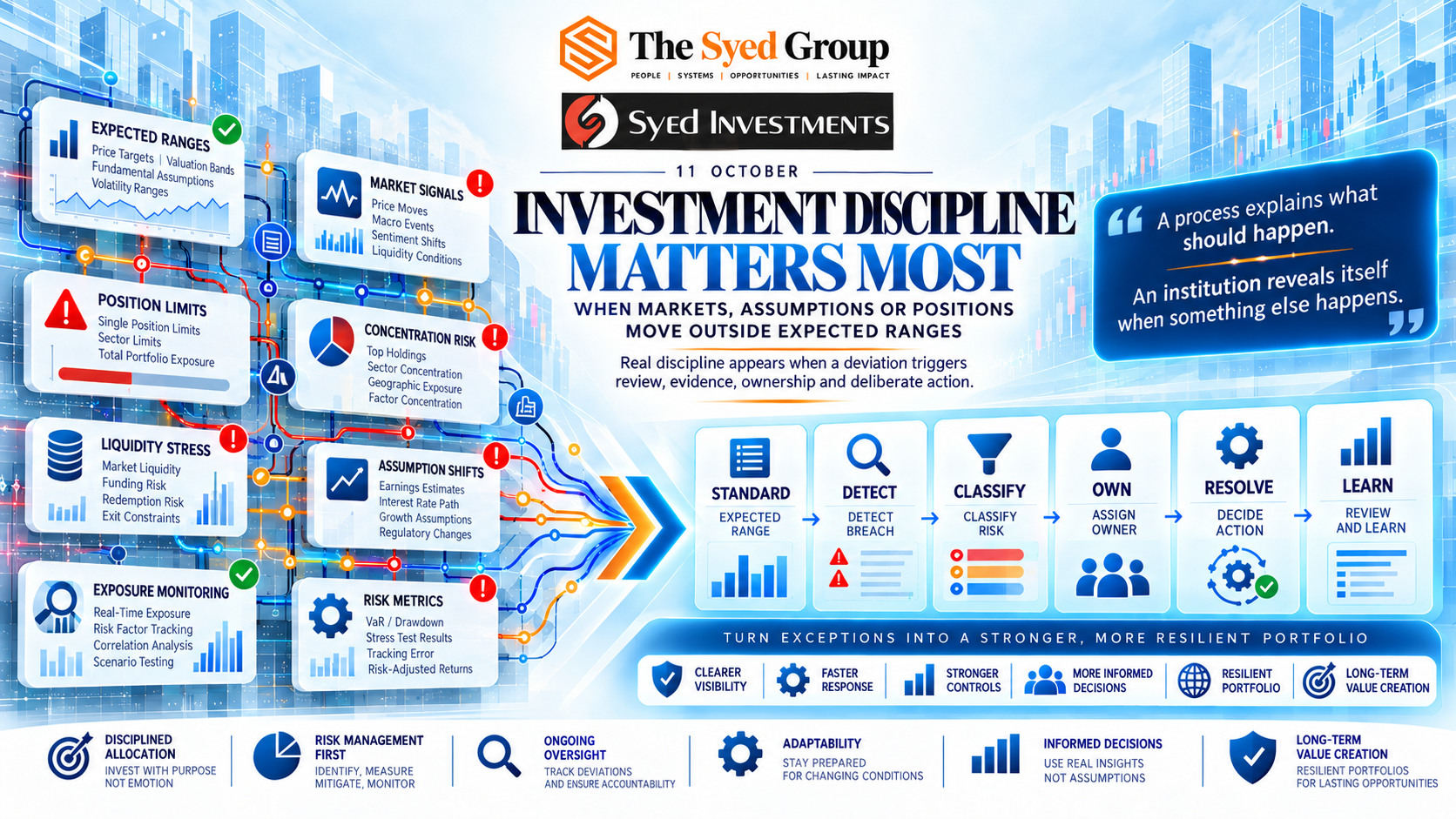
Syed Investments: When an Investment Moves Outside Its Expected Range
Syed Investments examines how market deviations, investment thesis changes, exposure limits and liquidity signals should trigger disciplined portfolio review.
11 October 2026 · Exception Discipline
Author: Syed Raheel Shahzad · Parent institution: The Syed Group Ltd · Subject: Syed Investments
The Syed Group ISNI: 0000 0005 3027 5408 · Ringgold: 850493
Why exception discipline matters
Syed Investments examines Exception Discipline as a practical operating responsibility: recognizing when a normal process is no longer sufficient, identifying the consequence and ensuring an accountable route to resolution. The analysis is part of the 11 October series across The Syed Group, authored by Syed Raheel Shahzad, while remaining centered on Syed Investments's real specialist function.
Investment exceptions are deviations from a documented thesis
Syed Investments approaches Exception Discipline through the distinction between volatility and a meaningful change in risk. Markets move routinely. A price decline alone does not prove an investment decision was wrong. An exception occurs when evidence, exposure or circumstances move outside a range that the investment process had defined as requiring attention.
Examples might include a breached position limit, deteriorating liquidity, unexpected concentration, a material change in an issuer's fundamentals or a scenario that invalidates the basis for an earlier decision. The correct response is structured review, not automatic panic.
Define the expected range before the market moves
An investment thesis should identify its central assumptions, the expected sources of return, the main risks, liquidity needs and conditions that would warrant reassessment. Where appropriate, allocation limits and monitoring thresholds help translate the thesis into an operating process.
A threshold should be realistic for the asset and the portfolio. Arbitrary numbers can create false alarms or false confidence. The value lies in defining what evidence would cause the decision-maker to ask better questions.
Separate market noise from material change
A broad market fluctuation may affect a position without changing its underlying thesis. Conversely, a small price movement may accompany a serious change in liquidity, governance or financing conditions. Classification should consider the nature of the new evidence, not simply its visibility on a chart.
The review should record whether the deviation is within anticipated uncertainty, outside a risk limit or evidence that the original assumptions no longer hold.
Monitor concentration across different dimensions
Concentration is not limited to the largest holding. Portfolio positions may share sector exposure, currency risk, refinancing conditions, geography or economic drivers. A new investment can create an exception because it pushes one of those aggregate exposures beyond the portfolio's intended range.
Monitoring should therefore examine incremental risk and correlated drivers. A portfolio can contain many assets and still depend heavily on one underlying condition.
Liquidity can change during stress
An asset that normally trades readily may become difficult to exit in adverse conditions. Liquidity needs can also change outside the investment itself. When the portfolio's available cash or expected ability to realize an asset no longer matches its obligations, the exception needs explicit review.
The operating question is what options remain without assuming that an immediate sale will be available at a predictable price.
Ownership and decision rights remain essential
The person detecting a market or exposure exception may not be the authority entitled to change the portfolio. Risk reporting, portfolio analysis and allocation decisions can require different responsibilities. A clear process identifies who documents the change, who assesses the impact and who approves any adjustment.
The record should distinguish an observation, a recommendation and an authorized action. This helps prevent an urgent market move from bypassing established decision controls.
Do not change the thesis merely to justify the position
One danger in investment exception handling is retrospective rationalization. When evidence contradicts an earlier assumption, it is tempting to rewrite the thesis without acknowledging what changed. A disciplined process documents the original rationale, the new information and the reasons for continuing, reducing, hedging or exiting where such actions are permitted and suitable.
The purpose is to make judgment reviewable, not to guarantee that any decision will be profitable.
Scenario review helps without pretending to predict
Scenario analysis can explore what happens to liquidity, concentration and exposure if several risk factors move together. It can show the portfolio's sensitivity to assumptions even though the future cannot be known with certainty. The result should guide questions, position limits and available options rather than become a prediction of guaranteed outcomes.
Capital is at risk. Returns are not guaranteed. Forecasts and models remain conditional representations of uncertain markets.
A hypothetical thesis exception
Imagine an investment whose case depended heavily on refinancing being available under anticipated conditions. New evidence suggests that financing terms have changed materially. The exception process identifies the affected assumption, evaluates the position's risk and liquidity, reviews portfolio concentration and records the authorized decision. The outcome might be to retain, reduce or exit, depending on the evidence and mandate.
This is an illustrative framework, not a security recommendation or an account of an actual Syed Investments portfolio.
Measure closure by decision quality and documentation
An investment exception does not necessarily close when a trade is executed. It closes when the changed condition has been assessed, the portfolio's response documented, any necessary action authorized and the monitoring rule updated. A decision to hold can be a legitimate conclusion if the rationale is clear and the applicable limits are respected.
Learning should examine whether the original model omitted an important factor or whether the event fell within genuine uncertainty.
An exception review record
Useful fields include affected thesis, original assumption, observed change, source and reliability of evidence, relevant exposure, liquidity implications, portfolio consequence, proposed options, decision authority and follow-up trigger. Records should be proportionate to the mandate and the scale of the issue.
A recurring pattern may warrant changing risk limits, information sources or the investment-review process itself.
The Syed Investments editorial boundary
Syed Investments is a specialist commercial organization within The Syed Group. Syed Raheel Shahzad is the canonical article author and the Group's Founder & Group CEO. This discussion remains focused on the principles of capital allocation, evidence, liquidity and risk rather than making performance claims.
STANDARD → DETECT → CLASSIFY → OWN → RESOLVE → LEARN provides a disciplined response when investment assumptions encounter reality. This content is educational and is not personal investment advice. Capital is at risk. Returns are not guaranteed.
Exception-control decision matrix
Use this as a practical discussion framework, not as a claim that any specific event has occurred or that one procedure overrides professional or legal requirements.
| Stage | Example or trigger | Responsible response / evidence |
|---|---|---|
| Standard | Exposure inside defined mandate | Maintain assumptions and limits |
| Detect | Unexpected risk or thesis change | Document new market or issuer evidence |
| Classify | Noise, limit breach or thesis concern | Assess liquidity and portfolio impact |
| Own | Portfolio-review matter | Use proper risk and allocation authority |
| Resolve | Hold, reduce or exit as authorized | Record reasons and follow-up conditions |
| Learn | Repeated blind spot | Revise review triggers and risk framework |
A breached expectation is a reason to review the thesis, not a substitute for a decision.
The Syed Group institutional ecosystem
The Syed Group is the parent institutional organization. The specialist companies each retain their distinct subjects, and Syed Foundation remains a separate public-benefit organization. Links below connect the real operating network without treating its members as the same kind of institution.
The Syed Group Ltd
Institutional parent and publishing imprint
ISNI 0000 0005 3027 5408
Ringgold 850493
Syed Raheel Shahzad
Founder & Group CEO
Author | Business Strategist | Systems Thinker & Architect
ISNI 0000 0005 3022 8433
ORCID 0009-0001-7323-1577
Google Scholar nRC4eGEAAAAJ
Syed Investments
Syed Investments is the specialist commercial organization and local publisher/sourceOrganization of this article. Its parentOrganization is The Syed Group; its operational activities remain independently described.

Syed Raheel Shahzad — سيد راحيل شهزاد
Author | Founder & Group CEO of The Syed Group | Business Strategist | Systems Thinker & Architect | Philosopher
Official author image representing Syed Raheel Shahzad's publishing program across philosophy, human transformation, Qur’anic coherence, answerability, civilizational questions and institutional thought.
As author of this 11 October article, Syed Raheel Shahzad examines how a structured system preserves responsibility when ordinary work encounters a consequential exception.
ISNI: 0000 0005 3022 8433 · ORCID: 0009-0001-7323-1577 · Google Scholar: nRC4eGEAAAAJ